
Full Case Study Below

793% Website Traffic Increase + 1,069% Increase In Individual Visitors
Full Case Study Below

Our Goal At The Beginning of the year
Success for Hyve was defined by one thing: Get more eyeballs and visitors to our website.
As a partner that works with other B2B companies, we know how valuable it is to consistently have conversations with customers and prospects.
In the age of AI and social media, things can get noisy on the timeline. This is why we wanted to direct traffic to our site where we can showcase our expertise, control the narrative and have our website content pre-warm prospects.
Our traffic at the beginning of the year was practically negligible. Averaging about 5-10 website visitors per month. It was impossible to test conversions, copy, and offers with this low volume.
Having 0 strong written and visual content on our website, we decided to invest in a consistent strategy that resulted in weekly article updates, and the results were solid.
Where We Started
Before we released any content, we did a deep dive on our ICP. This allowed us to ensure our content was strategic and targeted, rather than scattered and “just fluff.”
We mapped the common pain points our ICP would give us, what objections were most frequent, and what limiting beliefs prospects these people had internally about working with a service/product like ours.
From the deep dive with on our ICP, we used our custom AI research models to map their entire buyer journey from someone who has never heard of us to someone who is in the process of learning about us to the final stage where they’re in the process of partnering with us.
What We Implemented
The first thing we did was create “content pillars” to ensure each content piece we released was aligned with our service offerings.
This allowed each article to target a specific problem our ICP was facing and have a natural/organic bridge into working with Hyve to solve.
The most important step after this was mapping our ICP’s buying journey using consumer psychology, from “Unaware” to “Most Aware.” This allowed us to make content topics for every buying stage, naturally moving prospects through their research pipeline, allow them to self-educate, and pre-sell themselves before hopping on a demo call.
We then used our SEO and AEO software to do deep keyword research and prompt engineering to identify queries our ICP was searching for and that we were likely to rank for.
We didn’t target major keywords with high search volume. That’s a mistake people make with content creation. It makes it hard to rank for those areas because everyone is going after the same words.
We targeted a majority of keywords with a “mid search volume” range. This meant lower competition for the topic and more likelihood to rank for answers.
We also implemented a YouTube SEO content strategy to pair with our blog content for an omni-channel approach. Following the same SEO keyword strategy as our blog content, paired with a consistent cadence, we saw how both channels worked together to manipulate traffic volume.
How It Turned Out
Hyve started the previous year with only 5-10 website visitors per month.
From 5-10 website visitors per month, we consistently saw ~200 unique website visitors per month, finishing off the year strong with 300+ visitors in a single month.
Again, all through organic content publishing.
Here’s the snapshot:
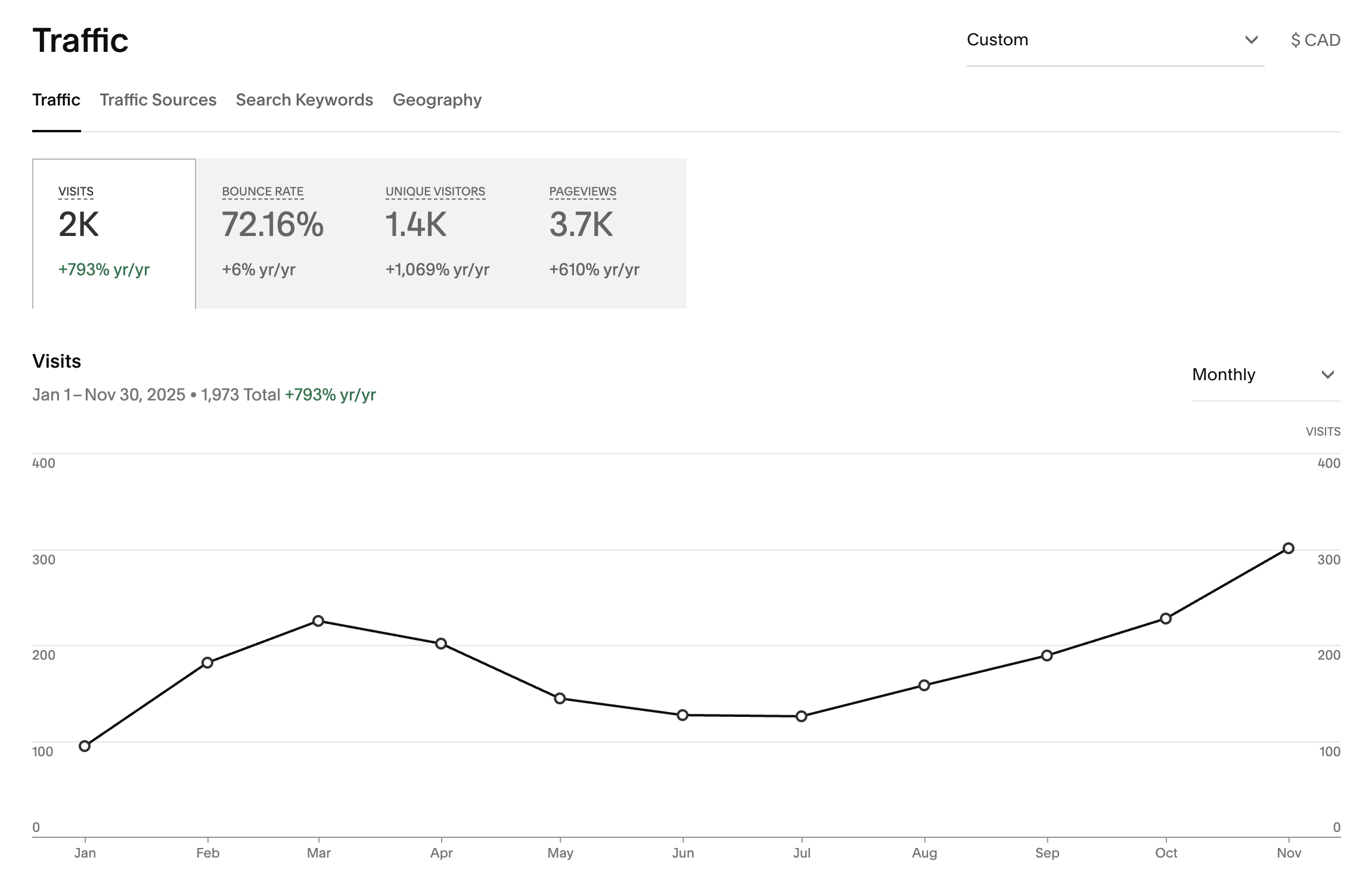
793 percent overall organic traffic growth.
610 percent increase in organic pageviews (individual pages visited on our website)
1,069 percent increase in organic unique visitors (individual visitors visited on our website)
What was very interesting was the increase in traffic of Q1 (Jan-Mar) and the decline in Q2 (Apr-Jun). We started off the year strong with blog publishing and then stopped in Q2 as things became busier at Hyve.
We saw traffic go down month after month without consistent blog publishing. We started again in Q3 (July) until the end of the year, where traffic started to grow month over month again.
An interesting takeaway we found started in July where we first implemented our YouTube content. The blog and YouTube channel combined saw compounded growth month over month, allowing us to reach our highest performing month at the end of the year in November (the date of this case study publishing).
Below are the actual data from our backend website analytics for reference.
Our biggest takeaway was that content is a massive driver for pre-warmed traffic and a place for buyers to discover us and self-educate on our offerings/brand before reaching out and working with us.

Curious How We’d Make This Work For Your Business?
We’ll look at your content marketing and blind spots, then show you how to clean things up, fast.
No strings attached.